
Changing careers is rarely a skills problem; it is a translation problem. You already have the abilities a new field wants, but your resume still describes them in the language of your old job, so recruiters and screening software miss the match. This is exactly where an AI resume generator earns its keep: instead of writing from a blank page, you paste your history and the target job posting, and the tool rewrites your experience in the vocabulary of the role you actually want.
Career switching is now normal, not exceptional. The U.S. Bureau of Labor Statistics reports that “the median number of years that wage and salary workers had been with their current employer was 3.9 years in January 2024” — the lowest figure since 2002, and just 2.7 years for workers ages 25 to 34 (BLS, Employee Tenure). Shorter tenures mean more transitions, and more transitions mean more resumes that have to bridge two different worlds.
Why a career-change resume is so hard to write
When you apply within your current field, your job titles do the explaining for you. A “Senior Accountant” applying for another accounting role reads as an obvious fit. A career changer loses that shortcut. Your old titles point backward, your bullet points are full of industry-specific tasks, and the person or system reading your resume has to work to see why any of it matters for the new role.
That reader is often not a person at first. Applicant tracking systems (ATS) scan and rank resumes before a recruiter opens them, matching your document against the keywords in the job description (see Applicant tracking system on Wikipedia). Career changers are the most likely to be filtered out here, because their resumes are written in the terminology of the field they are leaving, not the one they are entering. The skills are present; the matching words are not.

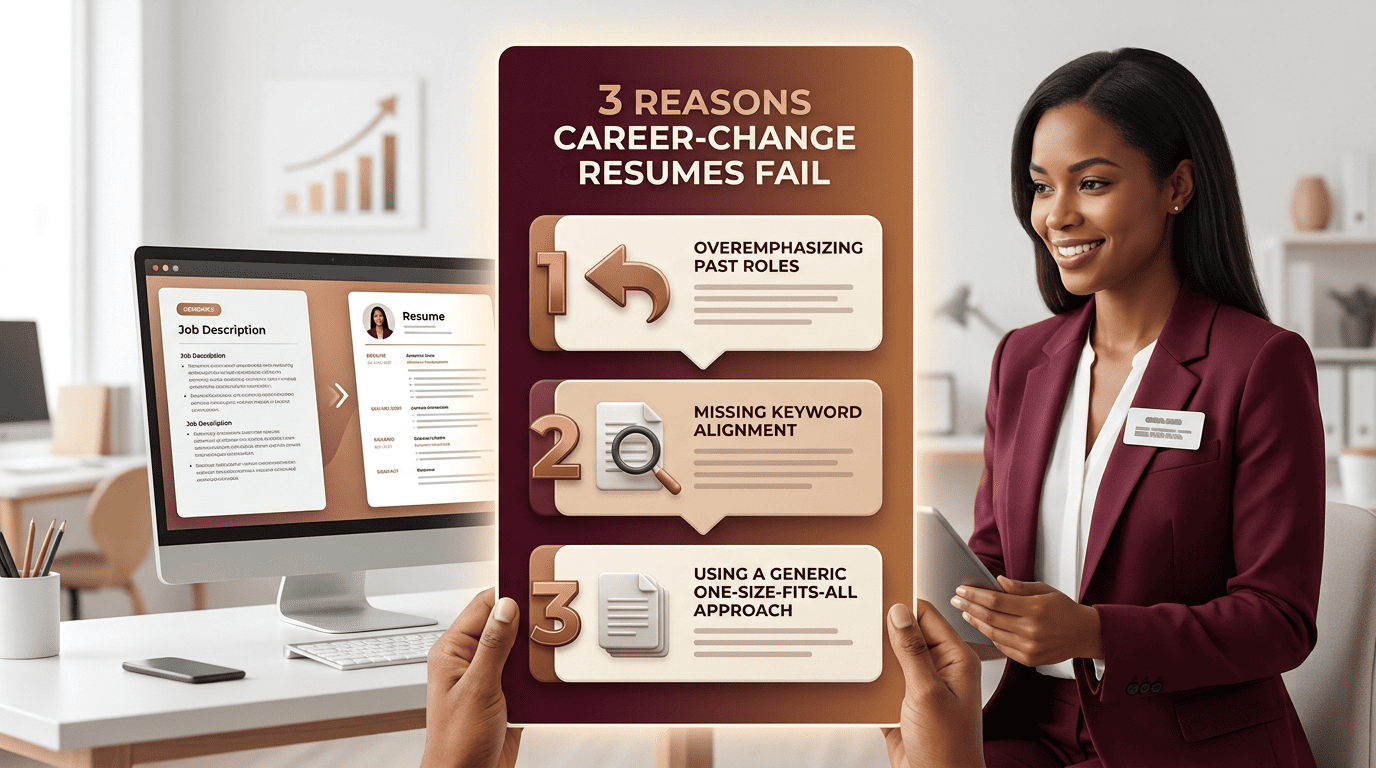
The three failure points that sink most career-change resumes are:
- Backward-facing titles that signal the wrong industry.
- Missing keywords from the target job description.
- Generic bullets that list duties instead of proving transferable outcomes.
What “transferable skills” actually means
Transferable skills are abilities that hold their value across roles and industries — project coordination, data analysis, stakeholder communication, budgeting, team leadership. The U.S. Department of Labor’s CareerOneStop frames them as the competencies you carry from one job to the next, and they are the entire foundation of a successful pivot.

The mistake most people make is assuming the reader will infer the transfer. They won’t. If you were a teacher and you write “planned and delivered daily lessons,” a hiring manager for a project coordinator role has to do the translating themselves — and busy hiring managers rarely bother. The winning move is to translate it for them: “coordinated recurring schedules and deliverables for 120+ stakeholders.” Same experience, reframed into the language of the target field. For a deeper look at how the underlying document is structured, our guide to AI resume generator templates breaks down which formats best absorb reframed experience.
How an AI-powered resume generator reframes your experience
An AI-powered resume generator is well suited to this translation work because it is fundamentally a language tool. Give it two inputs — your real experience and the job description you are targeting — and it can restate your accomplishments in the terminology the new role uses. Here is what a good tool does under the hood:
- Reads the job description and extracts the skills, keywords, and priorities of the target role.
- Maps your existing experience against those priorities, surfacing the overlaps you may not have noticed.
- Rewrites each bullet to lead with the transferable outcome, phrased in the new field’s vocabulary.
- Aligns keywords so the resume clears ATS keyword matching without stuffing.
- Tightens the summary, which is the one section where you directly control the career-change narrative.
The key word is reframe, not invent. The tool is not there to fabricate experience you don’t have — that is both dishonest and easy for interviewers to expose. It is there to make experience you genuinely have legible to a reader in a different field.
From job description to tailored resume, step by step
The fastest, most reliable workflow treats the target job posting as the blueprint. If you want to go deeper on this specific method, see our companion guide on building an AI resume from a job description. The short version:
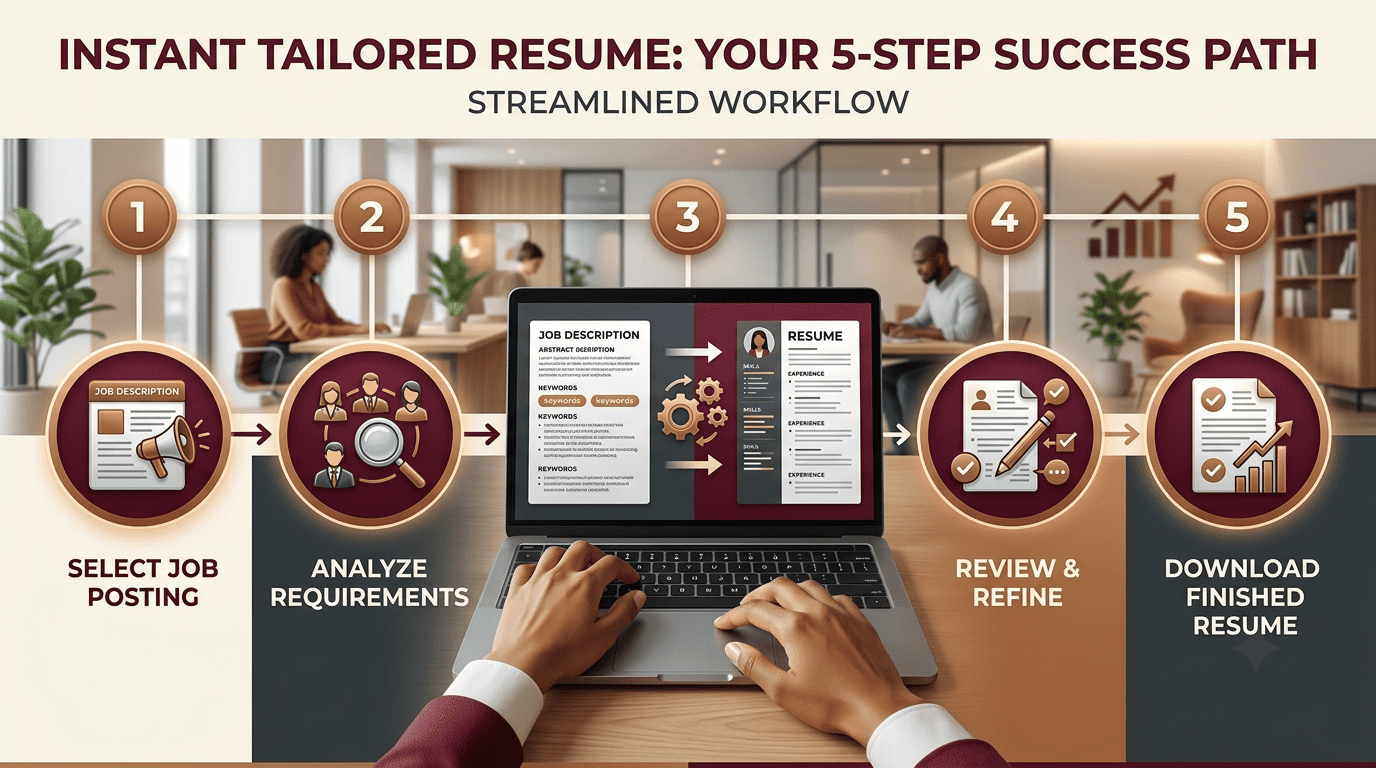
- Paste the target job description into the generator so it knows exactly what the new role values.
- Paste your full history — every role, project, and side responsibility, even the ones that feel unrelated.
- Let the tool draft a reframed version, then read it critically. AI drafts are a starting point, not a final answer.
- Add proof to every claim — a metric, a tool, a stakeholder count, a business result. “Improved efficiency” is weak; “cut monthly close time by 30%” is strong.
- Fact-check every line. Verify dates, titles, and numbers. Never publish an AI claim you cannot defend in an interview.
Reframing in practice: three examples
The table below shows how the same raw experience reads before and after an AI resume generator translates it for a new field.
| Old role → new role | Original bullet | Reframed bullet |
|---|---|---|
| Teacher → Project Coordinator | “Planned and taught daily lessons to five classes.” | “Coordinated recurring schedules and deliverables across five concurrent groups, tracking progress against weekly milestones.” |
| Retail Manager → Operations Analyst | “Managed a store team and handled inventory.” | “Owned inventory forecasting and workforce scheduling for a $1.2M location, reducing stockouts through weekly demand analysis.” |
| Nurse → Clinical Data Specialist | “Cared for patients and updated their charts.” | “Maintained accurate clinical records for 20+ patients per shift and flagged data discrepancies for escalation.” |
Notice the pattern: each reframe keeps the truth intact but re-centers the sentence on the outcome and the terminology the new field cares about.

Mistakes to avoid
- Over-trusting the first draft. AI output is competent but generic; personalize it or it reads like everyone else’s.
- Keyword stuffing. Matching the job description is good; copying it verbatim is transparent and often backfires.
- Inventing metrics. If you don’t know the exact number, use an honest, defensible range rather than a fabricated stat.
- One resume for every job. A career-change resume must be re-tailored per posting; the whole advantage is targeting.
- Deleting the human step. You still own the final review. The tool speeds you up; it does not replace your judgment.
What an AI resume generator can — and can’t — do
Be honest with yourself about the boundary. An AI resume generator can dramatically improve how your existing experience is presented, help you clear ATS filters, and save hours of staring at a blank document. It cannot give you skills you don’t have, guarantee an interview, or land you a job. Used this way, an AI resume builder tool is a fast, tireless editor that speaks the language of your target field — not a magic career button. The interviews you win will still come from real transferable ability, clearly communicated. The tool just makes sure that ability is finally visible to the people deciding your next step.
FAQ
Can an AI resume generator really help with a career change?
Yes, because a career change is largely a translation task and AI is a language tool. It reframes your existing experience into the vocabulary and keywords of your target field, which is precisely the step most career changers struggle with. It won’t invent experience, but it makes the experience you have far more legible to recruiters and ATS software.
Will a reframed resume get flagged as dishonest?
Not if you reframe rather than fabricate. Restating “planned daily lessons” as “coordinated recurring schedules and deliverables” is accurate — it’s the same work in different words. Problems only arise when people invent titles, metrics, or responsibilities. Keep every claim defensible in an interview and you’re on solid ground.
How do I make sure my career-change resume passes the ATS?
Paste the target job description into the generator so it can align your keywords with what the role actually asks for, and put your transferable skills in a clearly labeled skills section, which ATS software weights heavily. Avoid images, unusual fonts, and multi-column layouts that some parsers mishandle.
Should I use a functional or chronological resume for a career change?
A hybrid works best for most changers: a strong skills-and-summary section up top to control the narrative, followed by reverse-chronological experience so recruiters still see your timeline. Purely functional resumes can read as if you’re hiding something, and many ATS parsers handle them poorly.
Do I need to write a new resume for every job I apply to?
For a career change, yes — and this is where AI saves the most time. Because you’re targeting roles that don’t obviously match your background, each posting values slightly different transferable skills. Re-tailoring per application is what turns a generic pivot into a targeted one, and a generator makes that a few-minute task instead of an hour.
How much of the final resume should be AI-written?
Treat AI output as a strong first draft, not a finished product. Let it handle structure, phrasing, and keyword alignment, then add your real metrics, verify every fact, and rewrite anything that sounds generic. The best career-change resumes are AI-accelerated but human-owned.